 By Hamza@globalarena.org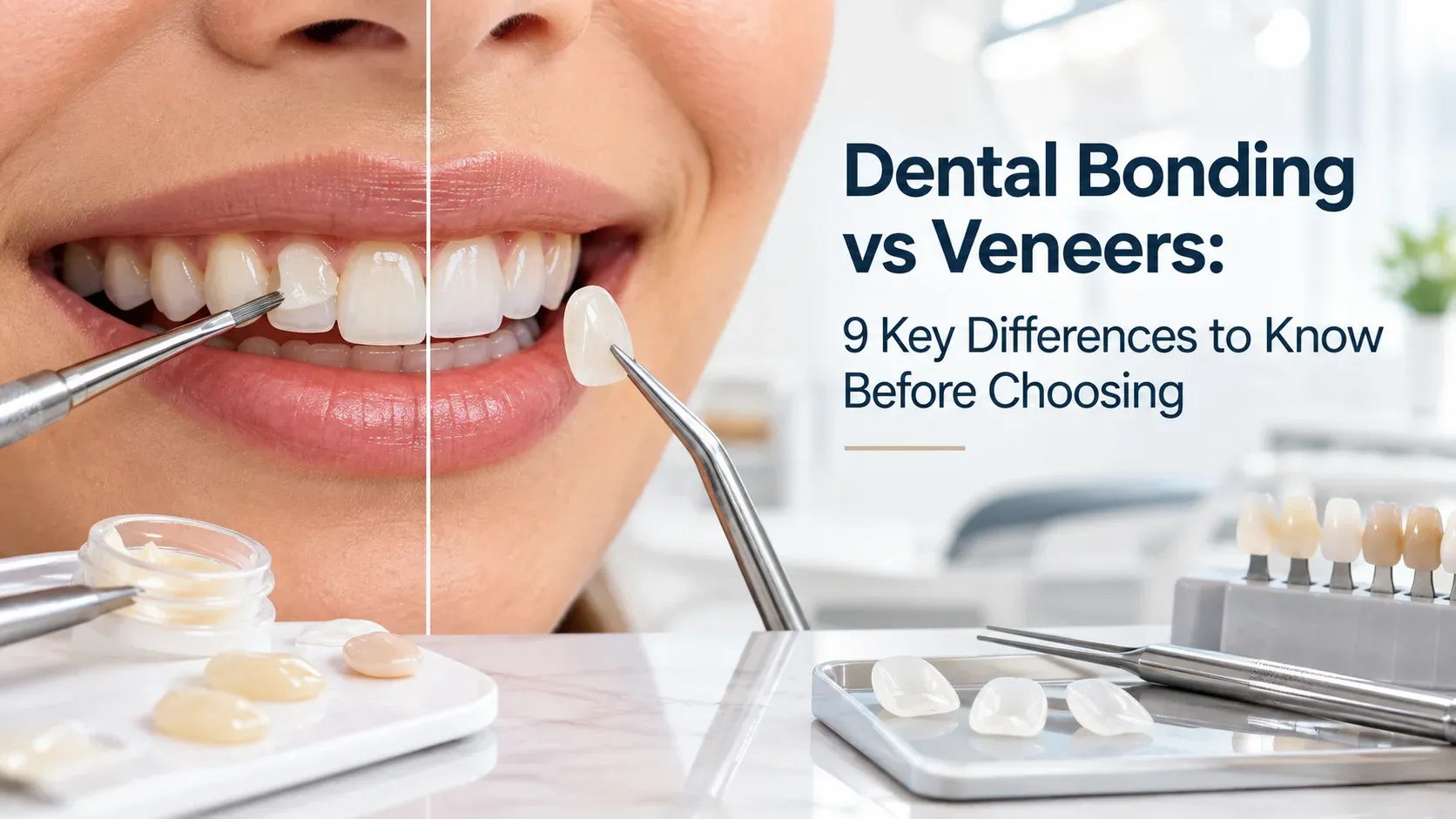
Choosing a cosmetic dental treatment can feel confusing when two options seem to promise a similar result. You may have chipped teeth, discoloration, small gaps, uneven edges, or simply want a more balanced smile. At that point, the question often becomes: should you choose bonding or veneers?
Understanding Dental Bonding vs Veneers starts with one important fact: these treatments are not the same. Dental bonding uses tooth-colored composite resin that your dentist applies and shapes directly on the tooth. Veneers are thin coverings placed over the front surface of teeth, with porcelain and composite being the two main types.
The right option depends on your teeth, oral health, cosmetic goals, bite, budget, and how much change you want to make.
This guide explains the major differences in simple terms so you can have a more informed conversation with your dentist.
What Is Dental Bonding?
Dental bonding is a cosmetic procedure that uses tooth-colored composite resin to alter the shape, size, or appearance of a tooth. Your dentist applies the material, shapes it, hardens it with a curing light, and then finishes and polishes the surface.
It can be used for relatively small cosmetic changes such as:
- Repairing minor chips.
- Closing certain small gaps.
- Improving tooth shape.
- Making a tooth appear slightly longer.
- Concealing some discoloration.
- Creating better visual balance between neighboring teeth.
Because the material is sculpted directly onto the tooth, your dentist has considerable control over the final shape.
For someone considering a conservative front teeth cosmetic treatment, Dental Bonding vs Veneers can help explain why bonding may be an appealing option when only modest changes are needed.
What Are Dental Veneers?
Dental veneers are thin coverings designed to attach to the front surfaces of teeth. They can be made from porcelain or composite materials. Porcelain veneers are custom-made ceramic shells, while composite veneers are made from tooth-colored resin material.
Veneers can address several cosmetic concerns, including:
- Discoloration.
- Chipped or broken teeth.
- Misshapen teeth.
- Certain gaps.
- Cosmetic irregularities.
- Smile symmetry concerns.
Porcelain veneers are fabricated to fit the individual teeth, while composite veneers can be sculpted directly on the tooth.
This difference in material and fabrication is important when comparing Dental Bonding vs Veneers.
1. Dental Bonding vs Veneers: How Are They Different?
The simplest way to understand Dental Bonding vs Veneers is to think about how the treatment is made.
With bonding, composite resin is applied directly to your tooth and shaped by the dentist. With a porcelain veneer, a custom-made ceramic shell is bonded to the front of the tooth. Composite veneers sit somewhere between these concepts because composite material can be bonded and shaped on the tooth as a veneer.
Here’s a quick comparison:
| Feature | Dental Bonding | Porcelain Veneers |
|---|---|---|
| Main material | Composite resin | Ceramic/porcelain |
| Application | Sculpted directly on tooth | Custom-made shell |
| Tooth preparation | Often minimal | Usually requires enamel preparation |
| Reversibility | Often more reversible | Generally not reversible |
| Typical treatment time | Often fewer visits | Usually multiple steps/visits |
| Repairs | Composite can often be repaired | Damaged veneer may need replacement |
| Stain resistance | More susceptible to staining | Generally highly stain-resistant |
| Cost | Usually lower | Usually higher |
| Longevity | Often shorter | Generally longer |
These are general comparisons, not guarantees. The exact procedure and longevity can vary according to the material, dentist, tooth condition, bite, and individual circumstances.
2. Composite Bonding vs Porcelain Veneers: What’s the Material Difference?
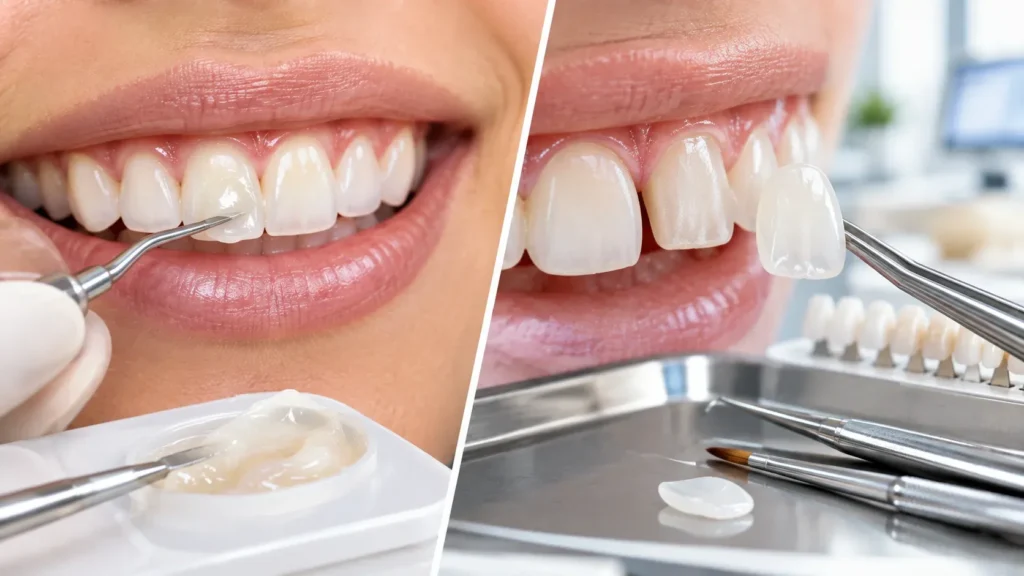
The difference between composite bonding vs porcelain veneers comes down largely to the material and how it is placed.
Composite is a resin-based tooth-colored material. The dentist can manipulate it directly on the tooth, allowing the shape to be adjusted during the appointment.
Porcelain is a ceramic material manufactured into a thin restoration. Its appearance can be highly natural because modern ceramics can mimic characteristics of natural tooth structure.
When considering Dental Bonding vs Veneers, the choice between composite resin vs porcelain is therefore not simply about which material looks better.
It also involves considerations such as:
- Tooth preparation.
- Durability.
- Repairability.
- Stain resistance.
- Treatment time.
- Cost.
- Desired cosmetic change.
Your dentist can assess which material is appropriate for your particular teeth.
3. Does Dental Bonding Require Tooth Shaving?
One of the questions patients commonly ask is, “Does dental bonding require tooth shaving?”
In many cases, dental bonding can be performed without significant enamel removal. The tooth may be prepared so the composite adheres properly, but the extent of preparation depends on the tooth and the treatment plan. Cleveland Clinic describes bonding as a minimally invasive option compared with treatments that require more enamel removal.
This is one reason Dental Bonding vs Veneers is an important comparison for people who want to preserve their natural tooth structure.
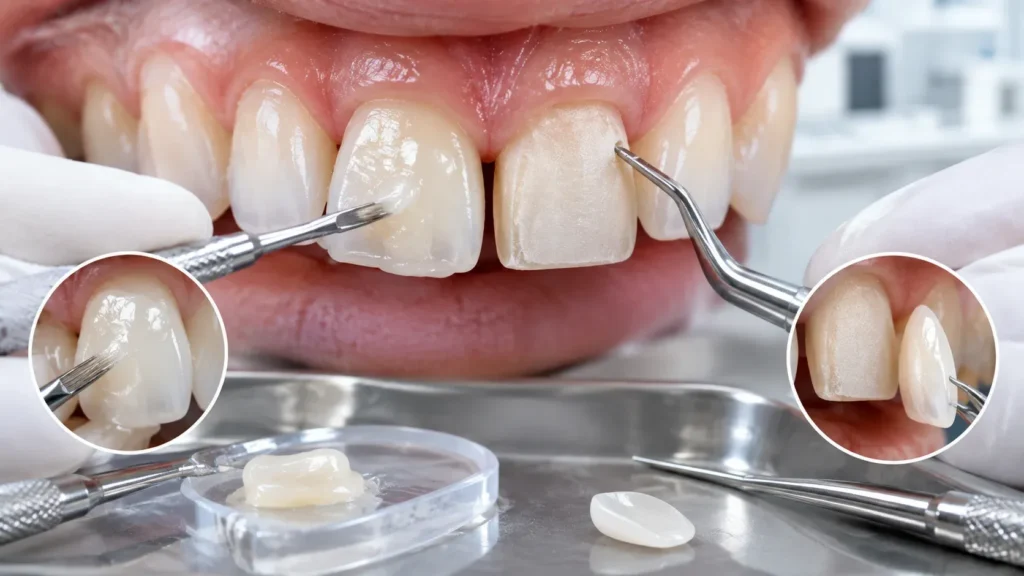
Veneers are different. Porcelain veneer placement generally involves removing some enamel from the front and sides of the tooth to create space and allow proper placement.
That does not mean veneers are inherently inappropriate. It simply means the treatment involves a different level of tooth preparation.
4. How Much Tooth Is Removed for Veneers?
The amount of tooth preparation required for veneers varies according to the veneer type, tooth position, desired result, and clinical plan.
Porcelain veneers generally require some enamel preparation. The purpose is to create an appropriate surface and space for the restoration rather than simply placing a thick shell over the tooth.
This is why a dentist should evaluate your teeth before treatment.
If you are researching Dental Bonding vs Veneers because you are concerned about enamel removal, ask your dentist exactly how much preparation is planned and why it is necessary.
A good consultation should explain the proposed changes rather than leaving you to guess from photographs or online examples.
5. Which Looks More Natural?
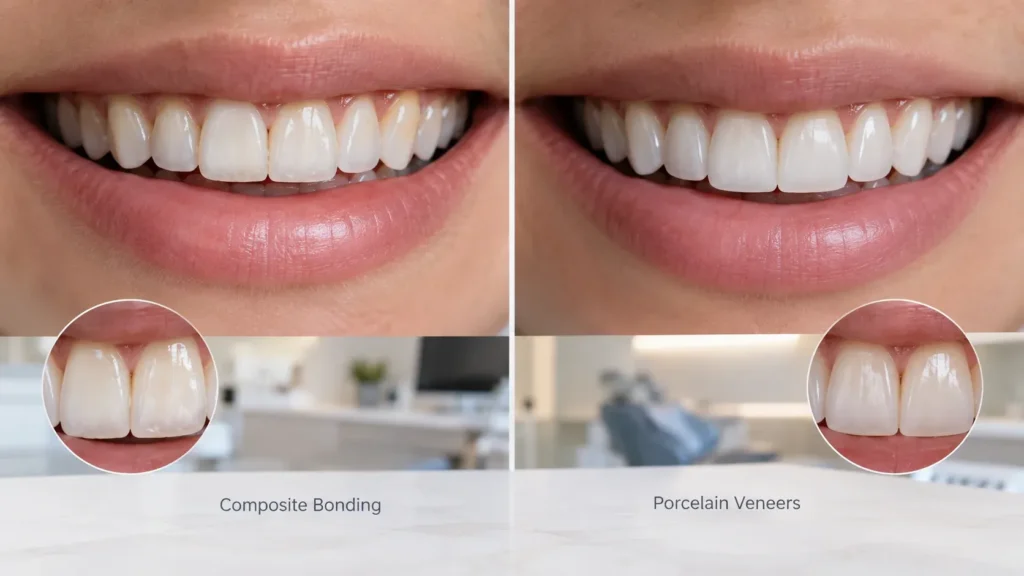
Both treatments can produce natural-looking results when properly planned and performed.
The final appearance depends on much more than the material itself. Tooth shape, proportions, color, surface texture, translucency, gum position, bite, and the relationship between neighboring teeth all matter.
For some patients, natural-looking veneers may provide the appearance they want because porcelain can be fabricated with detailed control over shape and optical characteristics.
Composite can also look very natural when carefully layered, shaped, finished, and polished.
So, can bonding look as natural as veneers?
It can, particularly when the cosmetic correction is relatively small and the composite is skillfully matched and sculpted. However, the visual result depends heavily on the case and the clinician’s technique.
6. Dental Bonding vs Veneers: Which Lasts Longer?
If longevity is your main concern, Dental Bonding vs Veneers requires a closer look at the materials and your individual circumstances.
Dental bonding is not permanent. Cleveland Clinic states that bonding commonly lasts around three to 10 years before touch-ups or replacement may be needed, although individual results vary.
Porcelain veneers can last longer. Cleveland Clinic notes that porcelain veneers may need replacement after around 10 to 20 years.
However, longevity should not be treated as a fixed expiration date.
Your results may be affected by:
- Bite forces.
- Teeth grinding or clenching.
- Oral hygiene.
- Eating habits.
- Number of teeth treated.
- Material quality.
- Placement technique.
- Regular dental care.
This means dental bonding vs veneers which lasts longer has a general answer, but your personal result can still vary.
7. Are Veneers Stronger Than Composite Bonding?
Porcelain veneers are generally more resistant to staining and can provide greater durability than composite bonding in appropriate clinical situations. Composite, however, has an important advantage: it can often be repaired more easily if a small portion chips or becomes damaged.
The question “are veneers stronger than composite bonding?” therefore needs some context.
Strength isn’t the only factor that matters.
For example, if a patient needs a small repair on one front tooth, the ability to make a conservative and repairable restoration may be important.
If a patient wants a broader cosmetic change across several teeth, a dentist may discuss porcelain veneers as one of the possible smile makeover options.
Your dentist should consider function as well as appearance.
8. What About Cost?
Cost is one of the biggest differences patients want to understand.
Dental veneers cost can be higher than composite bonding because porcelain veneers involve custom fabrication and additional laboratory or clinical steps.
Composite bonding cost is generally lower, although the actual price depends on the number of teeth, amount of material required, complexity of the case, location, dentist, and treatment plan.
Rather than comparing one advertised price against another, ask what the quoted fee includes.
For example:
- Consultation.
- Diagnostic assessment.
- Digital scans or impressions.
- Temporary restorations, if needed.
- Laboratory fabrication.
- Final placement.
- Adjustments.
- Follow-up care.
This is particularly important when comparing dental bonding vs porcelain veneers cost.
A lower initial price does not necessarily mean the same treatment, materials, preparation, or follow-up are being offered.
9. Which Is More Conservative?
For many people, one of the most important parts of Dental Bonding vs Veneers is the amount of natural tooth structure involved.
Bonding is generally considered a more conservative cosmetic option because it typically does not require significant enamel removal.
Porcelain veneers generally involve tooth preparation and are considered irreversible once enamel has been removed. The American Dental Association’s consumer guidance also emphasizes that porcelain veneer treatment is not reversible.
This does not make one treatment universally suitable and the other unsuitable.
A minimally invasive approach is useful when it can achieve the desired result without compromising the treatment goal.
If you only need a small chip repaired or a minor shape adjustment, bonding may be discussed.
If you want a more extensive change in color, shape, or overall smile appearance, veneers may be considered.
Tooth Bonding or Veneers for Chipped Front Teeth?
If you’re deciding between tooth bonding or veneers for a chipped front tooth, the size and location of the chip matter.
Small chips can often be repaired with composite bonding. The dentist can add resin to the missing area, shape it, cure it, and polish it.
Veneers may be considered when a cosmetic defect requires more extensive coverage or when there are additional aesthetic concerns involving the tooth.
The important thing is to have the tooth examined.
A chip caused by trauma may involve more than a cosmetic issue, and a larger fracture may require a different restorative approach.
Bonding or Veneers for a Smile Makeover?
A cosmetic smile makeover can involve several different treatments, depending on what you want to change.
Someone with relatively healthy teeth and a few minor cosmetic concerns might need only limited bonding.
Another person may have multiple issues involving tooth color, shape, size, spacing, and alignment and may require a broader treatment plan.
That is why there is no universal answer to bonding or veneers for smile makeover.
Your dentist may discuss bonding, veneers, whitening, orthodontics, contouring, or other dental restoration options depending on the condition of your teeth and your goals.
Can You Replace Veneers With Bonding?
In some situations, a dentist may be able to use bonding after a veneer has been removed or damaged, but this is not a simple one-size-fits-all replacement.
The underlying tooth condition, remaining enamel, existing preparation, bite, and cosmetic requirements all need to be evaluated.
If you are wondering, “Can you replace veneers with bonding?” the safest answer is that it depends on the individual tooth.
Your dentist can determine whether composite is appropriate or whether another restoration would provide a better result.
Can You Whiten Bonding and Veneers?
Whitening natural teeth and changing the color of existing restorations are not the same thing.
Composite bonding does not whiten in the same way natural enamel does. Porcelain veneers also maintain their existing shade rather than responding like natural tooth structure to conventional whitening.
Therefore, if you are considering whitening, it is useful to discuss your desired final shade before cosmetic restorations are placed.
This is especially important when several visible front teeth are being treated.
Composite Veneers vs Porcelain Veneers
Not all veneers are porcelain.
Composite veneers use tooth-colored resin and can be sculpted directly onto the teeth. They may require fewer visits and less enamel removal than porcelain veneers in some cases.
Porcelain veneers are custom-made ceramic shells that are bonded to the front surfaces of teeth. They generally involve more preparation and are usually more expensive, but they can offer strong aesthetic and durability characteristics.
This makes composite bonding vs porcelain veneers slightly different from comparing traditional bonding with porcelain veneers.
Your dentist may recommend composite veneers, direct bonding, porcelain veneers, or another treatment depending on how much change you need.
How to Care for Bonding and Veneers
Regardless of which cosmetic treatment you choose, your natural teeth and gums still need routine care.
Good habits include:
- Brush twice daily with fluoride toothpaste.
- Clean between your teeth daily.
- Attend regular dental examinations.
- Avoid biting very hard objects.
- Don’t use your teeth to open packaging.
- Discuss teeth grinding with your dentist.
- Follow the specific care instructions provided after treatment.
Composite can be more susceptible to staining than porcelain, while both types of restorations can be damaged by excessive force.
Your lifestyle matters too. Someone who frequently bites hard objects or grinds their teeth may have different maintenance needs from someone without these habits.
Who May Benefit From Bonding?
Bonding may be considered for patients who want relatively small cosmetic changes, such as:
- Minor chips.
- Small gaps.
- Slightly uneven edges.
- Changes in tooth shape.
- Small areas of discoloration.
- Slight changes in tooth length.
It can be particularly useful when preserving natural tooth structure is an important consideration.
However, active tooth decay, gum disease, significant fractures, or major bite problems may need to be addressed first.
Who May Consider Veneers?
Veneers may be discussed when a patient wants broader cosmetic changes involving several visible teeth.
They can address concerns such as discoloration, misshapen teeth, certain gaps, and cosmetic irregularities.
However, veneers require careful planning because porcelain veneer treatment is not reversible.
A dentist should assess your oral health, enamel, bite, expectations, and long-term maintenance before treatment.
Dental Bonding vs Veneers: A Simple Decision Guide
Rather than asking which treatment is universally better, think about what you actually want to change.
Bonding may be worth discussing if:
- You need a small cosmetic correction.
- You want a conservative approach.
- You have a minor chip or gap.
- You want a relatively straightforward treatment.
- You prefer a potentially lower initial cost.
Veneers may be worth discussing if:
- You want a more extensive cosmetic transformation.
- Several front teeth need changes.
- You want a ceramic restoration.
- Stain resistance is an important consideration.
- You understand that porcelain veneers generally involve irreversible preparation.
These are general considerations, not personal treatment recommendations.
FAQs: Dental Bonding vs Veneers
Is dental bonding better than veneers?
Neither treatment is automatically better for everyone. Bonding can be useful for smaller cosmetic changes and is generally more conservative, while veneers may be considered for broader aesthetic changes. Your dentist can compare both options based on your teeth and goals.
Should I get bonding or veneers?
The decision depends on the condition of your teeth, the amount of cosmetic correction you want, your bite, budget, and willingness to undergo tooth preparation. A dental examination is the best way to compare the options.
Which is more affordable, bonding or veneers?
Composite bonding is generally less expensive than porcelain veneers, but prices vary by dentist, location, number of teeth, and treatment complexity.
How long does bonding last compared with veneers?
Composite bonding commonly lasts several years and may require touch-ups or replacement sooner than porcelain veneers. Cleveland Clinic reports around three to 10 years for bonding and around 10 to 20 years for porcelain veneers, although individual results vary.
Can bonding look as natural as veneers?
Yes, well-planned composite bonding can look very natural. The result depends on material selection, tooth anatomy, shade matching, shaping, finishing, polishing, and the dentist’s technique.
Are veneers stronger than composite bonding?
Porcelain veneers generally offer greater durability and stain resistance than composite bonding in appropriate cases, but bonding has the advantage of being more readily repairable in many situations.
Does dental bonding require tooth shaving?
Dental bonding typically requires little or no significant enamel removal, although the tooth may be prepared to improve adhesion. The exact approach depends on the case.
How much tooth is removed for veneers?
The amount varies according to the tooth, veneer type, desired result, and treatment plan. Porcelain veneers generally require some enamel preparation.
Can you replace veneers with bonding?
Sometimes composite may be considered after veneers, but this depends on the existing tooth preparation, remaining enamel, bite, and overall condition of the tooth.
Can you whiten bonding and veneers?
Whitening products primarily affect natural teeth rather than changing the shade of existing composite or porcelain restorations. Discuss whitening before cosmetic treatment if you want all visible teeth to match.
Conclusion
Choosing between cosmetic treatments is easier when you stop looking for a universal winner and start looking at what your own teeth actually need.
Dental Bonding vs Veneers is ultimately a comparison between two different approaches to cosmetic dentistry. Bonding can offer a conservative way to make smaller changes using composite resin, while veneers can provide broader cosmetic coverage with a custom-made restoration.
Your decision should take into account tooth preparation, appearance, durability, maintenance, cost, oral health, and your long-term expectations.
A consultation with a qualified dentist can help you understand whether bonding, veneers, composite veneers, orthodontics, whitening, or another aesthetic dental treatment makes sense for your particular smile.
The most convincing cosmetic result is not necessarily the one that changes the most. It is the one that addresses the actual concern while keeping your teeth, bite, and long-term oral health in mind.