 By Hamza@globalarena.org
Not every uneven smile needs braces, veneers, or a major cosmetic dental treatment. Sometimes, one tooth is slightly shorter than the others, a front tooth has a small chip, or the edges simply do not look as balanced as you would like.
That is where dental bonding for uneven teeth can be worth considering.
This cosmetic treatment uses tooth-colored composite resin to add shape, length, or volume to selected teeth. Instead of changing the entire smile, your dentist can make small adjustments where they are actually needed.
The result can be subtle: teeth that look more even, a smoother smile line, and a more balanced appearance without dramatically changing your natural smile.
But is bonding suitable for every type of uneven tooth? How does it compare with tooth contouring? Can composite bonding fix worn teeth? And what happens if the material chips or stains?
Let’s look at what you should know before deciding.
What Is Dental Bonding for Uneven Teeth?
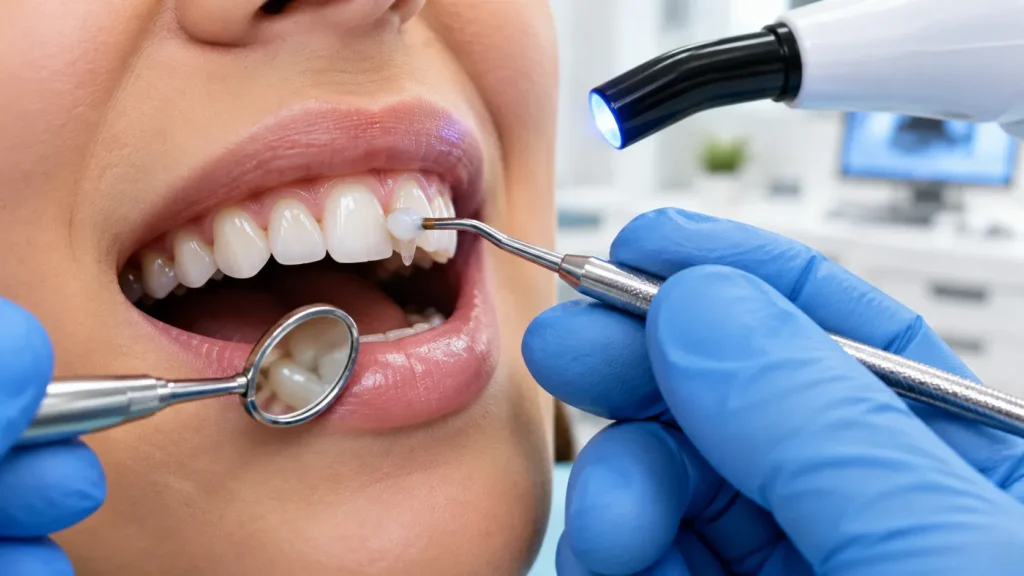
Dental bonding is a cosmetic dental technique in which a dentist applies a tooth-colored composite resin to the surface of a tooth, shapes it, hardens it with a curing light, and then finishes and polishes it.
The material can be used to make small changes to the appearance of a tooth, including its shape, size, length, and overall proportion.
For uneven teeth, the goal of dental bonding for uneven teeth is usually not to make every tooth look perfectly identical. Instead, the dentist aims to create better visual balance while keeping the result natural.
For example, bonding may be considered when:
- One front tooth is slightly shorter than its neighbor.
- A tooth has a small chip.
- The edge of a tooth looks irregular.
- A tooth appears narrower than the surrounding teeth.
- Minor wear has changed the shape of a front tooth.
- Small differences in tooth proportions affect the smile.
- A tooth needs a small amount of added length or width.
The important point is that bonding adds material to the tooth. That makes it different from treatments that remove enamel to change tooth shape.
1. Can Composite Bonding Fix Uneven Teeth?
In many minor cosmetic cases, composite bonding can improve the appearance of uneven teeth.
Imagine that one upper front tooth is slightly shorter than the tooth beside it. Rather than removing the longer tooth, a dentist may add a small amount of composite resin to the shorter tooth.
With dental bonding for uneven teeth, the resin is carefully shaped to follow the natural contours of the tooth. Once it is cured and polished, the difference in length can become much less noticeable.
The same principle can work for small chips, irregular edges, or teeth that look slightly different in width.
However, bonding does not physically move a crooked tooth into a new position. If unevenness is caused by significant crowding, rotation, bite problems, or major misalignment, orthodontic treatment may be more appropriate.
That is why an examination matters before choosing cosmetic treatment.
2. How Does Bonding Improve an Uneven Smile?
A smile is not simply about tooth color.
Tooth length, width, shape, edge position, and symmetry all influence how a smile looks. Even a small difference between two front teeth can sometimes be noticeable.
Dental bonding for uneven teeth can enhance your smile by allowing the dentist to make carefully planned composite additions to selected teeth.
Depending on the situation, this may involve:
- Adding length to a short tooth.
- Rebuilding a chipped corner.
- Softening an irregular edge.
- Adding width to a narrow tooth.
- Improving the proportions between neighboring teeth.
- Creating a smoother-looking smile line.
The best result is usually one that does not immediately look like dental work.
Good cosmetic bonding should complement your existing teeth rather than make your smile look artificial.
3. What Happens During the Treatment?
One reason patients consider dental bonding for uneven teeth is that it can be relatively straightforward compared with some other cosmetic dental treatments.
Your dentist will first examine your teeth and gums and discuss what you want to change.
The process may include several stages.
Shade selection
The dentist chooses a composite shade that works with your natural teeth and the planned result.
Tooth preparation
The tooth surface is prepared so the bonding material can adhere properly. The exact preparation depends on the tooth and the treatment plan.
Composite application
The dentist applies the composite resin to the selected area and gradually shapes it.
Sculpting and contouring
This is where the dentist’s experience becomes particularly important.
The composite needs to follow the natural anatomy of the tooth instead of looking like a flat layer placed over it.
Curing
A dental curing light hardens the material.
Finishing and polishing
Finally, the dentist checks the shape, bite, edges, and surface before polishing the restoration.
The goal is a comfortable and natural-looking composite resin restoration that fits visually and functionally with the surrounding teeth.
4. Dental Bonding vs Tooth Contouring: What’s the Difference?
This is one of the most important differences to understand before treatment.
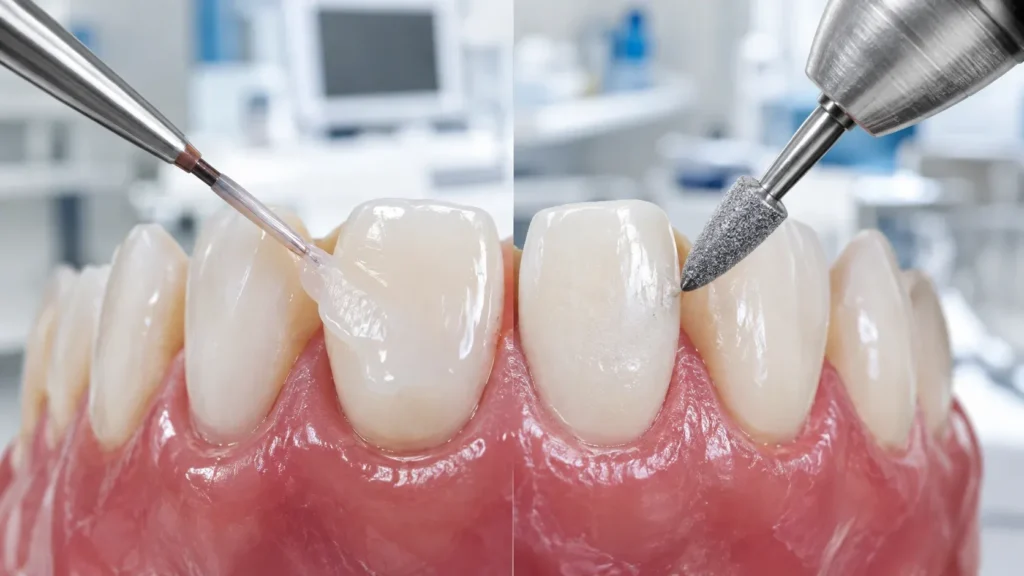
Bonding adds material. Tooth contouring removes a small amount of enamel.
When comparing dental bonding for uneven teeth with tooth contouring, it’s important to know that contouring, also called enameloplasty or odontoplasty, involves carefully reshaping a tooth by removing very small amounts of enamel.
For example, contouring may be considered when a tooth has:
- A slightly uneven edge.
- A small amount of excess enamel.
- A point that looks too prominent.
- A minor irregularity in shape.
Bonding works in the opposite direction.
Instead of removing tooth structure, composite resin is added to change the visible shape.
Enameloplasty vs bonding
| Feature | Dental Bonding | Tooth Contouring |
|---|---|---|
| Basic approach | Adds composite resin | Removes a small amount of enamel |
| Best suited to | Adding length, width or repairing small defects | Minor reshaping and smoothing |
| Tooth structure | Usually preserves the existing shape | Permanently removes some enamel |
| Material added | Yes | No |
| Can be reversed? | Generally more reversible than enamel removal | Enamel does not grow back |
| Treatment choice | Depends on tooth shape and desired change | Depends on whether enough enamel can safely be reshaped |
Neither option is automatically better.
Your dentist needs to determine whether the tooth requires something to be added, removed, or both.
Enameloplasty should also never be attempted at home because excessive enamel removal can cause permanent problems.
5. Can Bonding Repair a Chipped Front Tooth?
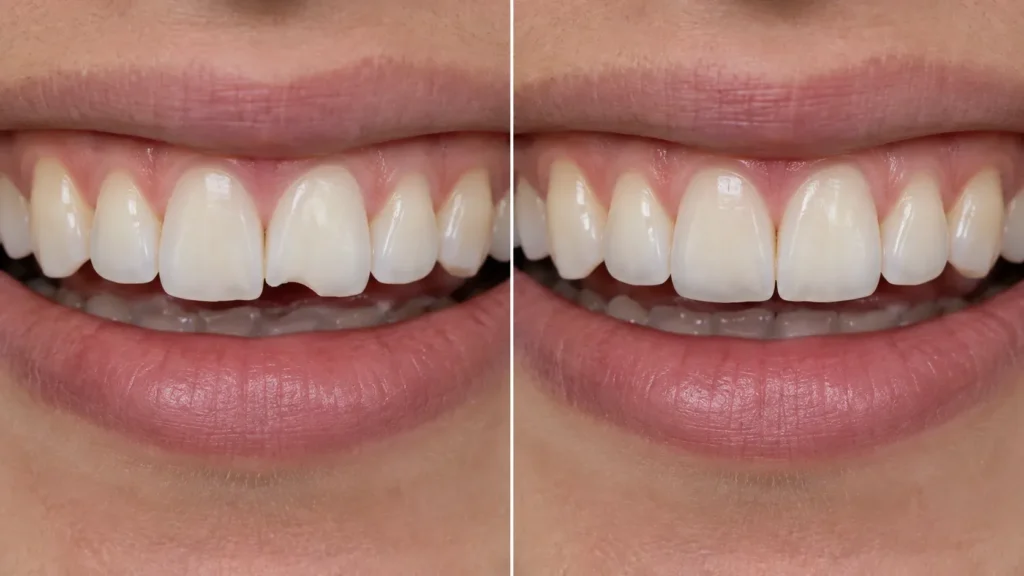
Yes, small chips are one of the common reasons dentists use composite bonding.
A chipped front tooth can make the edge appear uneven, especially when you smile.
During dental bonding for uneven teeth, composite resin can be shaped to replace a missing portion and recreate a more natural-looking edge during front tooth repair.
The amount of bonding required depends on the size and location of the chip.
A small cosmetic chip may be suitable for bonding, while a larger fracture may require a different restorative approach.
It is also important to understand why the tooth chipped in the first place. If the tooth was damaged by trauma, decay, grinding, or another dental problem, that underlying issue should be assessed rather than simply covering the visible defect.
6. Can Dental Bonding Repair Worn Teeth?
Bonding may sometimes be used to improve the appearance of mildly worn teeth, but the cause of the wear matters.
Teeth can become worn for different reasons, including grinding, clenching, dietary factors, or other dental conditions.
If a patient has significant tooth wear, simply adding composite through dental bonding for uneven teeth may not be enough. The dentist may first need to determine why the wear is occurring and whether the bite is contributing to it.
For appropriate cases, composite can restore some lost shape and improve the appearance of worn front teeth.
This is another reason why cosmetic treatment should begin with a dental assessment rather than choosing a procedure based only on photographs.
7. Does Dental Bonding Damage Teeth?
One of the reasons people choose bonding is that it can often be performed with relatively conservative preparation.
However, that does not mean every bonding procedure is suitable for every tooth.
The dentist needs to check:
- Tooth and gum health.
- Existing restorations.
- Bite and tooth contact.
- The amount of correction required.
- Whether the tooth has enough healthy structure.
- Whether habits such as grinding could affect the result.
Healthy teeth generally provide a better foundation for cosmetic treatment.
If you have untreated decay, gum problems, significant tooth damage, or another oral health issue, that problem may need to be addressed first.
When used as part of minimally invasive cosmetic dentistry, dental bonding for uneven teeth aims to improve the appearance of your smile while preserving as much healthy tooth structure as possible.
8. How Long Does Composite Bonding Last?
Composite bonding is not considered a permanent restoration.
How long it remains attractive and functional can vary considerably from person to person.
Factors that can affect its longevity include:
- Where the bonding is placed.
- How much composite is used.
- Your bite.
- Eating and chewing habits.
- Teeth grinding or clenching.
- Oral hygiene.
- Exposure to staining foods and drinks.
- The quality of the original placement and finishing.
- Regular dental maintenance.
Bonding can also chip or become worn over time.
That does not necessarily mean the entire treatment has failed. In some situations, a dentist may be able to repair or polish a small area rather than replacing everything.
After dental bonding for uneven teeth, it’s important to have any damaged bonding assessed rather than ignoring a sharp edge, change in bite, or visible fracture.
9. How Do You Care for Composite Bonded Teeth?
Good bonded teeth care can help maintain the appearance of your smile.
The basics are similar to good oral hygiene for natural teeth.
Brush regularly with a soft toothbrush and fluoride toothpaste, clean between your teeth, and maintain routine dental appointments.
You should also be mindful of habits that place unnecessary stress on bonded areas.
Try not to:
- Bite your fingernails.
- Chew ice.
- Bite pens or other hard objects.
- Use your teeth to open packages.
- Bite directly into very hard foods with a fragile bonded edge.
How to prevent composite bonding from staining
Composite can be more susceptible to surface staining than natural enamel or porcelain restorations.
Coffee, tea, tobacco and other strongly pigmented substances can contribute to discoloration over time.
After dental bonding for uneven teeth, you do not necessarily have to eliminate everything you enjoy, but good oral hygiene and sensible habits can help keep the surface looking cleaner.
If the bonding begins to look dull or stained, ask your dentist whether professional polishing could help.
Avoid aggressive DIY whitening or abrasive products without professional advice, particularly if the bonding is visible because whitening does not necessarily change the color of existing composite in the same way it changes natural tooth enamel.
Can You Repair Composite Bonding If It Chips?
A small chip does not always mean the entire tooth needs to be rebonded.
Depending on the location and size of the damage, a dentist may be able to smooth, polish, or repair the affected area.
However, the correct approach depends on the condition of the underlying tooth and the remaining composite.
If your bonding suddenly feels sharp, your bite feels different, or a significant piece has broken away after dental bonding for uneven teeth, arrange a dental examination.
Do not try to glue the material back yourself.
Is Dental Bonding Better Than Veneers for Uneven Teeth?
There is no universal answer.
Bonding and veneers are different treatments with different advantages and limitations.
Bonding uses composite resin that is shaped directly on the tooth. Veneers are custom-made restorations that cover the front surface of the tooth.
Bonding can be attractive for someone who wants a relatively conservative cosmetic correction, especially when only a small change is needed.
Veneers may be considered when a patient wants a more extensive cosmetic transformation or when the condition of the teeth makes another restoration more appropriate.
When considering dental bonding for uneven teeth, the right choice depends on your teeth, bite, expectations, budget, and the amount of correction required.
A consultation can help you compare the options instead of assuming that one treatment is automatically best.
What About Bonding vs Tooth Contouring?
The decision becomes simpler when you think about what your tooth actually needs.
If a tooth is slightly too long or has a small irregular projection, contouring may be enough.
If a tooth is too short, too narrow, or missing a small section, adding composite may make more sense.
Sometimes dentists may even consider a combination of approaches, depending on the individual smile.
The key is not to remove healthy enamel simply because a tooth looks uneven.
A professional assessment helps determine how much change is actually needed and which approach is safest.
Who Is a Good Candidate for Dental Bonding?
A suitable candidate is generally someone with healthy teeth and gums who wants a relatively small cosmetic improvement.
Bonding may be worth discussing if you are concerned about:
- Uneven front teeth.
- Small chips.
- Minor differences in tooth length.
- Slightly irregular edges.
- Small shape discrepancies.
- Mild tooth wear.
- Other minor cosmetic imperfections.
However, bonding may not be the best solution for severe misalignment, extensive damage, active dental disease, or situations where a different treatment would provide a more predictable result.
A dentist should assess the individual case before recommending treatment.
What Are the Benefits of Dental Bonding?
For the right patient, bonding can offer several practical advantages.
Natural-looking cosmetic improvement
The composite can be shade-matched and shaped to blend with surrounding teeth.
Conservative approach
Bonding can often make cosmetic changes without the extensive preparation associated with some other restorations.
Targeted treatment
You may only need one or a few teeth treated rather than changing your entire smile.
Quick cosmetic correction
Many straightforward bonding procedures can be completed in a relatively short appointment.
Repair as well as reshaping
The same material can be used for certain minor chips and cosmetic defects.
Smile balance
Small changes in tooth length, width, or shape can make the smile appear more harmonious.
What Are the Limitations?
It is just as important to understand what bonding cannot do.
Composite is not indestructible.
It can:
- Chip.
- Wear.
- Stain over time.
- Require polishing or repair.
- Need replacement eventually.
And bonding is not a substitute for orthodontic treatment when significant tooth movement is required.
If your teeth are substantially crowded, rotated, or misaligned, your dentist may recommend orthodontic evaluation instead.
The best cosmetic result comes from matching the treatment to the actual problem.
How Much Does Dental Bonding Cost?
The cost of dental bonding varies by location, dentist, number of teeth, amount of composite required, and complexity of the case.
A single small repair will generally involve a different amount of work than reshaping several front teeth.
Instead of choosing a clinic based only on the lowest advertised price, consider the dentist’s experience, treatment planning, materials, finishing technique, and follow-up care.
For a cosmetic procedure, the quality of the planning and final contour can have a major effect on how natural the result looks.
FAQs: Dental Bonding for Uneven Teeth
Can composite bonding fix uneven teeth?
Composite bonding can improve the appearance of some mildly uneven teeth by adding tooth-colored resin to selected areas. It is most appropriate for relatively small cosmetic changes rather than major tooth movement or severe misalignment.
Can dental bonding make short teeth longer?
Yes. In suitable cases, composite resin can be added to the visible edge of a short tooth to increase its apparent length and create better balance with neighboring teeth.
Can bonding fix a small chipped front tooth?
Yes. Small chips on front teeth are commonly treated with tooth-colored composite resin. The dentist shapes the material to recreate the missing area and then finishes and polishes it.
Does composite bonding damage teeth?
Bonding itself is designed as a conservative cosmetic treatment, but suitability depends on the condition of your teeth and the treatment plan. A dentist should evaluate your oral health and bite before treatment.
What happens when dental bonding chips?
A dentist can assess whether the composite can be polished, repaired, or replaced. Do not attempt to repair chipped bonding yourself.
Can you whiten composite bonding?
Whitening treatments primarily affect natural tooth structure and generally do not whiten existing composite in the same way. If your natural teeth change shade while the bonding remains the same, your dentist can discuss the best approach.
How do you prevent composite bonding from staining?
Maintain good oral hygiene, keep up with professional dental care, and be mindful of frequent exposure to strongly staining substances such as coffee, tea and tobacco. Your dentist can also assess whether polishing is appropriate if surface staining develops.
Is bonding better than tooth contouring?
Not necessarily. Bonding adds composite, while tooth contouring removes small amounts of enamel. The better option depends on whether your tooth needs material added or minor reshaping through enamel removal.
Can composite bonding repair worn teeth?
It can sometimes restore the appearance of mildly worn teeth, but the cause of the wear should be investigated first. Grinding, clenching, bite problems, or other factors may need to be addressed.
Conclusion
Uneven teeth do not always require a major smile makeover.
For the right patient, dental bonding can make small but meaningful changes by adding composite resin where a tooth needs a little more length, width, shape, or support. It can also repair certain small chips and cosmetic imperfections.
But the best result is not simply about adding material to a tooth. It is about knowing where to add it, how much to add, how it should follow the natural tooth anatomy, and whether bonding is actually the right treatment in the first place.
If your teeth look uneven, a dentist can compare options such as bonding, tooth contouring, veneers, or orthodontic treatment and explain which approach fits your smile.
A natural-looking result should always start with a proper dental examination and a treatment plan designed around your individual teeth—not a one-size-fits-all cosmetic solution.