 By Hamza@globalarena.org
There are moments when you look at the person you married and simply want to place his wellbeing in Allah’s hands. Maybe your husband is under pressure at work. Maybe he is traveling, struggling spiritually, dealing with health concerns, or you are both going through a difficult season. In moments like these, a sincere dua can be a quiet way to ask Allah for what you cannot control.
Islam does not teach us that a particular phrase is a magic formula that guarantees another person will change. Dua is more personal than that. You ask Allah for goodness, guidance, protection, mercy, and what is best for your marriage.
This guide brings together Quranic supplications, simple personal duas, and practical ways to make them part of your routine. You will also learn how to pray for your husband’s love, health, rizq, faith, protection, and peace without treating worship like a formula with guaranteed results.
Prayer for Husband: Start With the Right Intention
A sincere prayer for husband can begin with something very simple: wanting good for him and for your marriage. You do not need complicated Arabic, a special object, or an elaborate routine before speaking sincerely to Allah.
One of the most relevant Quranic duas is found in Surah Al-Furqan 25:74:
“Rabbana hab lana min azwajina wa dhurriyyatina qurrata a’yunin waj’alna lil-muttaqina imama.”
A commonly used translation is: “Our Lord, grant us from among our wives and offspring comfort to our eyes and make us an example for the righteous.” The verse is a supplication for spouses and family as a source of comfort and righteousness.
Notice what makes this dua beautiful. It is not simply asking for romance. It asks for a relationship that brings comfort and is connected with righteousness. That gives you a wider way to think about your own prayer.
You can ask Allah to help your husband become stronger in faith, kinder in character, healthier, protected from harm, successful through halal means, and supportive within the marriage. You can also ask Allah to improve your own patience and behavior.
1. Dua for Husband’s Love, Affection, and Mercy
Wanting love in a marriage is natural. But Islamic marriage is not described only in terms of attraction. The Qur’an speaks about tranquility, affection, and mercy between spouses in Surah Ar-Rum 30:21.
This verse describes spouses as a source of tranquility and says Allah placed affection and mercy between them.
That makes it a meaningful foundation for a sincere dua when your concern is emotional closeness.
You might say in your own words:
“Ya Allah, place sincere affection, mercy, understanding, and kindness between my husband and me. Help us speak gently, forgive each other, and protect our marriage from resentment and unnecessary conflict.”
This is different from asking for control over another person’s heart. You are asking Allah for a healthy relationship and for qualities that support it.
If you are feeling emotionally distant from your husband, try not to turn every prayer for husband into a request for him to behave exactly as you want. Ask for what is genuinely good. Maybe you need better communication. Maybe he needs relief from stress. Maybe you both need to learn how to listen without immediately becoming defensive.
Dua can sit alongside those efforts.

2. Quranic Dua for Husband’s Guidance and Righteousness
A wife may worry about her husband’s faith, habits, decisions, or the direction he is taking in life. A Quranic dua for husband can be especially meaningful when your concern is not simply what he can provide for you, but who he is becoming.
The supplication in Al-Furqan 25:74 asks for spouses and offspring who are a comfort and for the family to be connected with righteousness.
You can also make a personal supplication such as:
“Allah, guide my husband toward what is pleasing to You. Strengthen his faith, give him wisdom in his decisions, keep him away from harmful choices, and make righteousness easy and beloved to him.”
There is no need to pretend that you know exactly how Allah should answer. Guidance can appear in many forms. A person may become more consistent in salah, more patient with family, more careful with money, or more willing to admit mistakes.
And remember that guidance is not something you can force. You can advise with wisdom, set healthy boundaries, and make dua, but you cannot control another adult’s heart.
That can actually make dua more peaceful. You are handing the outcome to Allah while still doing your part.
3. Prayer for Husband’s Protection From Harm
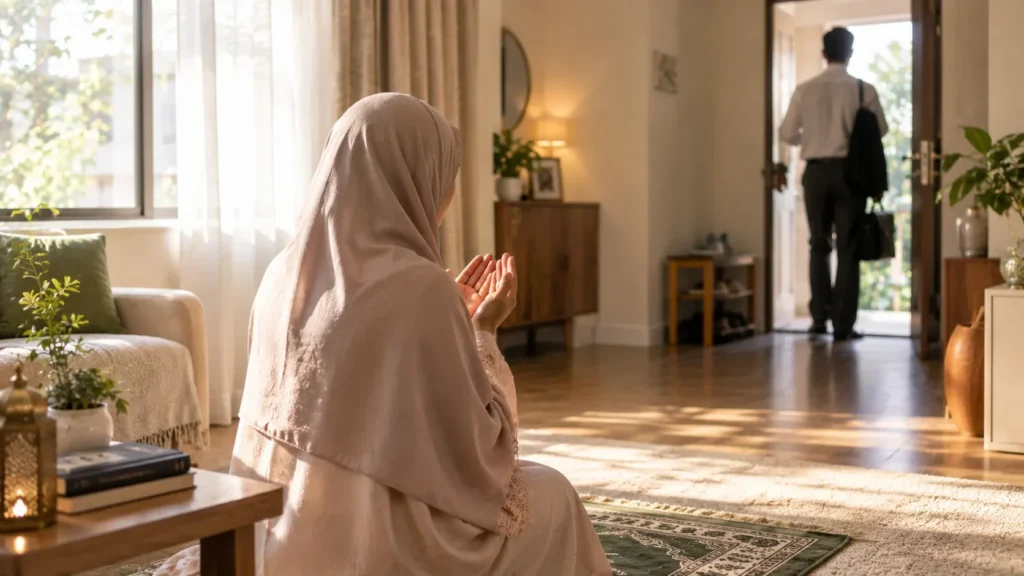
When someone you love leaves the house, travels, works long hours, or faces difficult people, worry can easily take over. A sincere prayer for husband can be a way to turn that worry into sincere supplication.
Ask Allah to protect your husband from physical harm, serious wrongdoing, destructive influences, and decisions that could damage his life or family.
A simple personal dua could be:
“Ya Allah, protect my husband wherever he goes. Keep him safe from harm, accidents, injustice, temptation, and people who wish him harm. Give him good judgment and bring him home safely.”
You can also pray for spiritual protection. Ask Allah to protect him from arrogance, dishonesty, anger that leads to injustice, harmful habits, and anything that pulls him away from what is right.
There is comfort in knowing that your husband does not have to be physically beside you for you to pray for him. Sahih Muslim records a hadith stating that when a Muslim supplicates for another Muslim in their absence, an angel says “Ameen” and asks that the same be granted to the person making the supplication.
That makes private dua especially meaningful. You can pray for him quietly without expecting him to know you did it.
4. Dua for Husband’s Health and Wellbeing
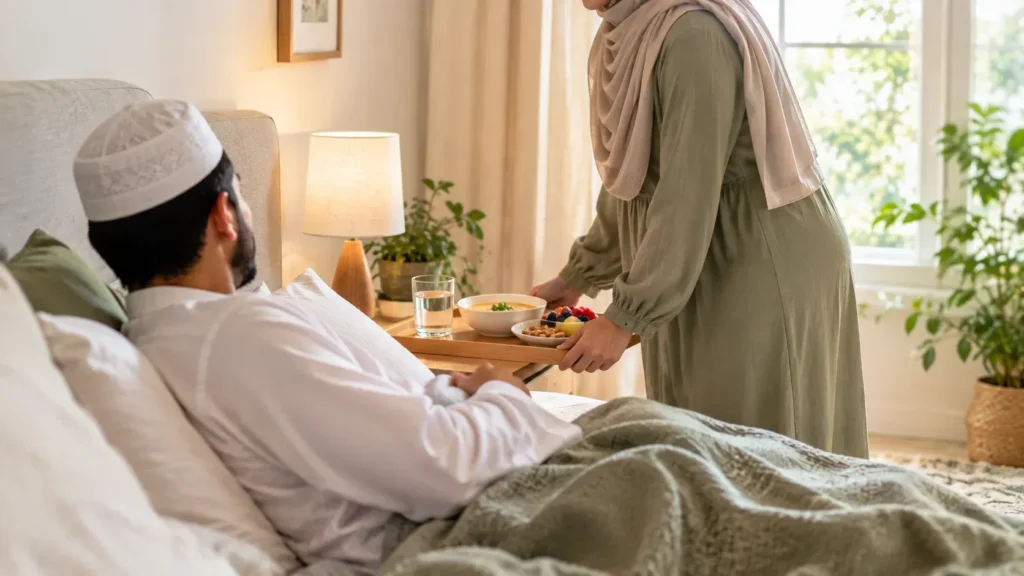
Health is one of those things we often appreciate most when something goes wrong. If your husband is sick, recovering from an injury, exhausted, or simply under constant stress, make his wellbeing part of your daily dua.
You might say:
“Allah, grant my husband health and strength. Ease his pain, give him energy for what is good, protect his body and mind from harm, and make his recovery easy if he is unwell.”
Keep the wording simple. You do not need to create a dramatic prayer to make it sincere.
You can also include these concerns in your prayer for husband, asking Allah to support healthy habits such as better sleep, moderation, emotional stability, wise choices, and the willingness to seek appropriate treatment when necessary.
If your husband has a serious medical problem, dua should not replace medical care. Prayer and practical treatment can exist together. Encourage him to speak with qualified healthcare professionals, follow appropriate advice, and take reasonable steps toward recovery.
The same principle applies to mental and emotional strain. If he is overwhelmed by work, family responsibilities, grief, or financial pressure, ask Allah to give him ease and then consider how you can support him in practical ways.
Sometimes the most loving response is not a perfect sentence in Arabic. It is a calm conversation, a meal left for him when he comes home late, or simply listening without trying to solve everything immediately.
5. Dua for Husband’s Rizq, Work, and Responsibilities
Financial pressure can quietly affect a marriage. A husband may be carrying worries that he does not always explain. He may be looking for work, trying to grow a business, managing debt, or simply trying to provide for the household.
A sincere dua can include his rizq and work without making money the measure of his worth.
Try a personal dua like:
“Ya Allah, provide my husband with halal, wholesome, and sufficient rizq. Put barakah in his work, guide him toward good opportunities, protect him from dishonest earnings, and give him wisdom when making financial decisions.”
The word “halal” matters here. The goal is not simply more money. It is lawful provision with barakah and peace.
You can also ask Allah to help your husband carry responsibility without becoming consumed by it. More income is not always the answer to every financial problem. Sometimes what a family needs is better planning, fewer unnecessary expenses, a healthier work-life balance, or the courage to ask for help.
A thoughtful dua can hold all of these concerns together.
6. Prayer for Husband During Marital Problems
This is where many people search for help. When arguments become frequent, communication breaks down, or one spouse feels ignored, a dua can become a source of emotional steadiness.
But a personal dua should not be treated as a secret method for controlling him.
Instead, ask Allah for clarity, fairness, patience, and reconciliation where reconciliation is genuinely good.
For example:
“Allah, bring peace to our home. Help my husband and me understand one another. Remove unnecessary anger and resentment from our hearts, guide us toward honest communication, and show us the right way forward.”
Then look at what you can do outside prayer.
If you regularly interrupt each other, work on listening. If conversations always happen when one of you is exhausted, choose a calmer time. If money is the trigger, discuss the actual numbers instead of arguing about character. If extended family is creating tension, agree on respectful boundaries.
And if the situation involves abuse, threats, coercion, or serious danger, do not assume that praying quietly means you must tolerate it. Seek appropriate support and safety.
Dua is not a substitute for addressing harm.
7. How to Make Dua for Your Husband in a Simple Daily Routine
You do not need to turn your day into a complicated schedule. A sustainable routine is usually easier to maintain than a long list of prescribed actions.
Here is a simple approach:
After salah
Take a few moments to ask Allah for your husband’s faith, health, protection, rizq, and character. Then include your marriage and your own shortcomings.
During sujood
Sujood can be a deeply personal time for supplication. Speak sincerely to Allah and ask for the things you genuinely need.
In the quiet part of the night
If you wake for voluntary prayer, use some of that quiet time to make dua. You can ask for your husband specifically or for the wellbeing of your entire family.
When he is away
Make dua for him while he is traveling or working. You do not need to wait for a crisis before remembering him.
When you feel angry
This may be the hardest time to pray sincerely. Before sending an angry message or continuing an argument, pause. Ask Allah to help you respond with justice rather than simply reacting to hurt.
A sincere dua becomes more meaningful when it changes how you approach the relationship too.
Is There One “Most Powerful” Dua for a Husband?
Search results often make people look for a single prayer that will solve everything. Islam does give us beautiful established supplications, but it is better not to treat worship like a guaranteed formula.
The dua from Al-Furqan 25:74 is especially relevant because it asks for righteous spouses and children who are a comfort to the heart.
Surah Ar-Rum 30:21 also gives a powerful picture of marriage built around tranquility, affection, and mercy.
Beyond these verses, you can ask Allah directly in your own language. If your husband is sick, ask for health. If he is struggling with faith, ask for guidance. If your home is tense, ask for peace and wisdom.
The sincerity of the request matters more than making the wording sound impressive.
Also be cautious with websites that promise that a certain number of repetitions, a certain number of days, or a particular ritual will definitely make a husband fall in love, return home, or obey. Unless a practice is supported by a reliable Islamic source, it should not automatically be presented as an established Sunnah.
Can I Make a Personal Dua for My Husband?
Yes, you can ask Allah for specific good things in your own words. Personal supplication allows you to explain what is actually happening in your life.
For example, instead of saying only, “Give my husband success,” you might say:
“Allah, if this new opportunity is good for my husband, our family, and our faith, make it easy and put barakah in it. If it is harmful, turn us away from it and guide us toward something better.”
That kind of prayer recognizes something important: we do not always know what outcome is best.
A prayer for husband can therefore include both a request and surrender. You ask sincerely, but you leave the final outcome with Allah.
FAQs About Prayer for Husband
What is a good prayer for husband in Islam?
A good prayer can ask Allah to bless your husband with faith, good character, health, protection, halal rizq, and wisdom. Qur’an 25:74 is especially relevant because it asks for spouses and offspring who are a comfort to the heart and for righteousness.
Can I make a prayer for husband in my own language?
Yes. Personal dua can express what is in your heart. You can use Arabic supplications from the Qur’an and Sunnah, then speak to Allah about your specific situation in a language you understand. The key is sincerity rather than complicated wording.
What dua can I make for my husband’s love?
You can ask Allah to place affection, mercy, kindness, and understanding between you. Surah Ar-Rum 30:21 describes marriage in terms of tranquility, affection, and mercy, making it a meaningful verse to reflect on when asking for a loving relationship.
Can I pray for my husband when he is away?
Yes. Supplicating for another Muslim in their absence is specifically mentioned in Sahih Muslim, where the angel responds with “Ameen” and asks for the same for the person making the supplication. This can make private dua for an absent husband especially meaningful.
How often should I make a prayer for husband?
There is no need to turn personal dua into a rigid ritual unless a particular practice is established by a reliable source. You can make dua regularly after salah, during sujood, at night, or whenever you sincerely feel the need to ask Allah for your husband and marriage.
Conclusion
A sincere prayer for husband does not have to be long or beautifully worded. Sometimes the most honest dua is simply, “Allah, take care of him and guide us both toward what is good.”
The Qur’an gives us a beautiful picture of marriage through tranquility, affection, and mercy, while Qur’an 25:74 reminds believers to ask for spouses and families who bring comfort and righteousness. Those ideas give you plenty to pray about.
Ask for your husband’s health, faith, protection, character, halal rizq, and wellbeing. Ask for your own patience and wisdom too. And when there is a real problem, pair dua with sensible action rather than waiting for a miracle to do all the work.
Start tonight with one sincere supplication. Mention your husband by name if you wish, tell Allah what concerns you, and then leave the outcome in His hands.